I re-engineered underwriting submission triage using an autonomous agent workflow. Here is the exact architecture and the API costs.
Triaging 1,200 commercial property submissions a month for a London MGA with four Claude agents costs about $383 a month in API fees, modelled to save around 1,500 hours.
Every commercial property underwriter knows the inbox. Brokers send submissions by email: a cover note, a schedule of values in whatever spreadsheet layout their client uses, five years of loss runs, a survey report, sometimes a 40-page presentation. Most of it has to be re-keyed before anyone can say whether the risk is even one the firm writes. Meanwhile the broker has sent the same risk to six other markets, and the first sensible answer wins.
The firm here is a London managing general agent writing commercial property under a delegated-authority binder. It receives about 1,200 submissions a month, roughly 55 a working day. About a fifth are outside its classes and could be declined in a minute, if someone read them. The rest wait in a queue behind the re-keying, and a good risk can sit for three days before an underwriter opens it.
The redesign doesn't price risks or bind anything. It gets every submission to an underwriter's desk the same day, clean, with a recommendation and the evidence behind it. Pricing and negotiation stay where they are and are left out of both sides of the sums below.
The MGA here is a composite: the volumes are typical for a mid-sized London property MGA, and every cost below is computed from Claude API list prices on 10 November 2026.
the process today
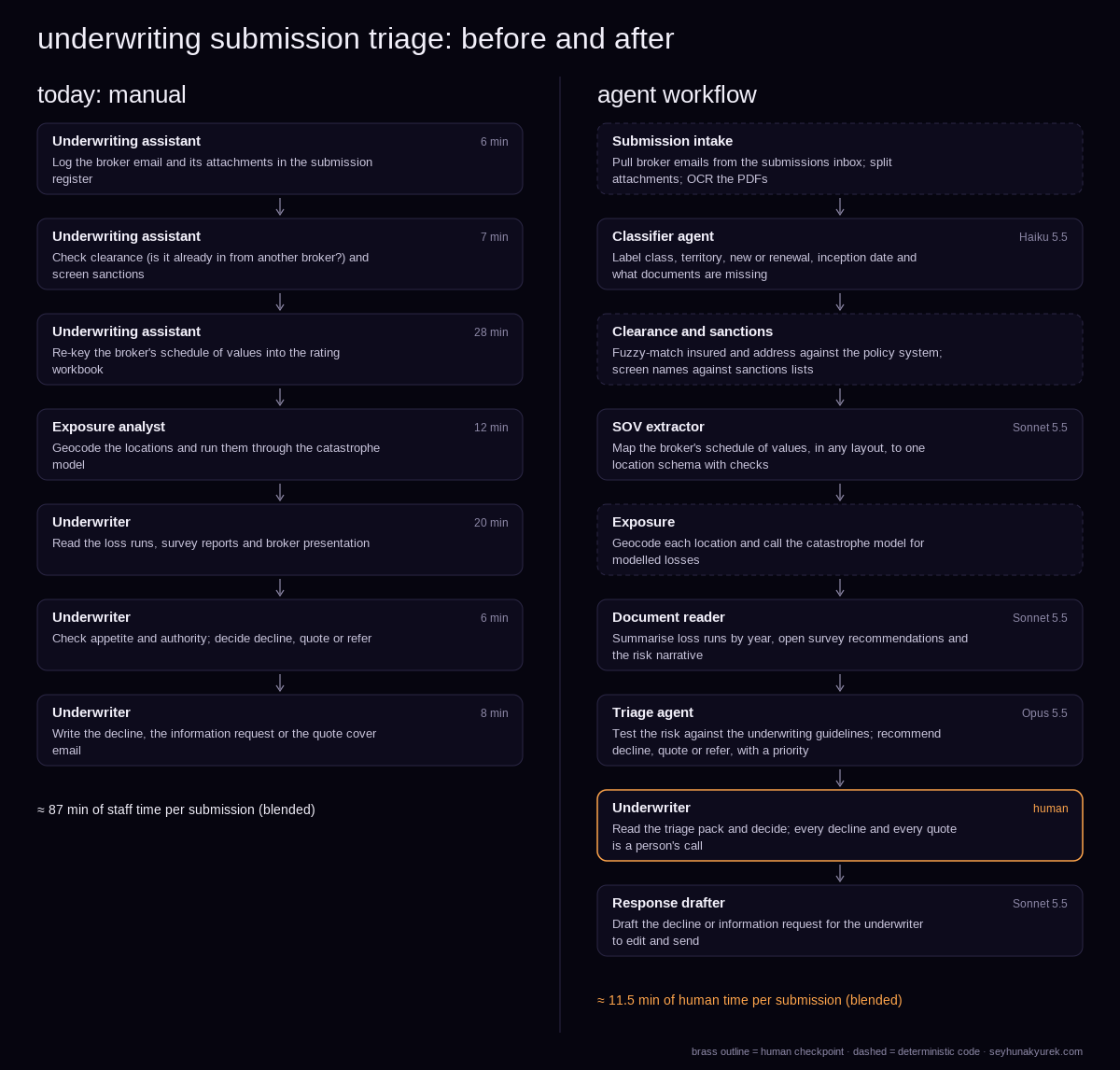
| step | who | minutes |
|---|---|---|
| Log the broker email and its attachments in the submission register | Underwriting assistant | 6 |
| Check clearance (is it already in from another broker?) and screen sanctions | Underwriting assistant | 7 |
| Re-key the broker's schedule of values into the rating workbook | Underwriting assistant | 28 |
| Geocode the locations and run them through the catastrophe model | Exposure analyst | 12 |
| Read the loss runs, survey reports and broker presentation | Underwriter | 20 |
| Check appetite and authority; decide decline, quote or refer | Underwriter | 6 |
| Write the decline, the information request or the quote cover email | Underwriter | 8 |
| Total per submission (blended) | 87 |
These are blended averages. A single-site risk takes ten minutes; a 300-location schedule takes most of a day. At 1,200 submissions that is about 1,740 hours a month, or ten to eleven people, before anyone has priced anything.
The time goes into the schedule of values. Every broker and every client lays it out differently: one row per building or per site, total insured value split into buildings, contents and business interruption or not, construction in ISO classes or in prose, addresses with or without postcodes. The errors come from the same place: a transposed TIV, a location left off, a sprinklered warehouse keyed as unprotected. The second cost is order. Submissions are worked first in, first out, so a risk the MGA would happily write waits behind twenty it will decline.
the agent architecture
The pattern is a pipeline with one router at the front. Every submission goes through intake and classification. Out-of-class submissions skip to the response drafter with a decline for the underwriter to approve. Everything else goes through clearance, extraction, exposure, document reading and triage in a fixed order. I chose a pipeline over an orchestrator because the order never changes, and an underwriter or an auditor must be able to see exactly what each step did to a submission.
Intake, clearance, sanctions screening, geocoding, the catastrophe model call and every arithmetic check are ordinary code. The models read and judge; they never call the rating engine or touch the policy system.
submission intake (deterministic)
A service reads the submissions mailbox, splits each email into its attachments, converts spreadsheets to a normalised table and sends PDFs through a cloud OCR service. Each submission gets an ID in the submission register, and the broker gets an automatic acknowledgement with that reference.
classifier agent
- Job: label the submission: class of business, territory, new or renewal, inception date, broker, and which of the documents the guidelines expect are missing.
- Model: Haiku 5.5. It is short classification against a cached taxonomy, on every submission, so the cheapest tier fits.
- Inputs and outputs: the email body, the attachment list and the first page of each attachment; returns the labels, a confidence per label and a list of missing documents. No tools.
- Guardrails: class and territory must come from the cached list. Under 0.85 confidence on class, the submission is never routed to a decline; it goes on to the full pipeline.
clearance and sanctions (deterministic)
Code fuzzy-matches the insured's name and main address against open submissions and policies in the policy administration system. A hit means another broker already has the risk in, and the underwriter decides who holds it. Names of the insured and its listed owners are screened against the UK, EU, UN and US sanctions lists through the firm's existing screening provider. A possible match stops the submission until compliance clears it.
SOV extractor agent
- Job: map the schedule of values, in whatever layout it arrives, to one location schema: address, occupancy, construction, year built, storeys, sprinklers, and TIV split into buildings, contents and business interruption.
- Model: Sonnet 5.5. This is extraction with judgement about what a broker's column means. Large schedules are split into chunks of about 60 rows, about three calls per submission on average.
- Inputs and outputs: the normalised table and a cached schema with mapping examples; returns location rows, the column mapping it used, and a confidence per field. No tools.
- Guardrails: code checks that the extracted TIV totals match the schedule's own totals to the pound, and that every source row appears once. A mismatch sends the schedule to an underwriting assistant with the rows that differ.
exposure (deterministic)
Code geocodes each location and calls the firm's licensed catastrophe model for flood, windstorm and earthquake scores and modelled losses. Locations that don't geocode to street level go to the exposure analyst. This step has no model call: the numbers must come from the licensed model, not from a language model's estimate.
document reader agent
- Job: turn loss runs, survey reports and the broker's presentation into a one-page summary: losses by year with paid and outstanding amounts, large losses and their causes, open survey recommendations, and the risk narrative.
- Model: Sonnet 5.5, about two calls per submission.
- Inputs and outputs: the OCR text and a cached summary template; returns the summary with a page reference for every figure. No tools.
- Guardrails: code re-adds the losses by year and compares them with the loss run's totals. A figure without a page reference is dropped from the summary.
triage agent
- Job: test the risk against the underwriting guidelines and recommend decline, quote, or refer to a senior underwriter, with a priority and the reasons.
- Model: Opus 5.5. This is the judgement step, and the one where a wrong answer costs most: a good risk declined is lost premium, a bad one quoted is a loss later. It runs once per in-scope submission.
- Inputs: the classifier labels, the location rows, the exposure results, the document summary, the broker's history with the firm, and a cached copy of the guidelines: appetite by occupancy and construction, territory limits, line size and aggregate limits per catastrophe zone, and the binder's authority limits.
- Outputs: a recommendation, a priority from 1 to 5, the guideline clauses it relied on, and what is missing for a quote.
- Guardrails: anything outside the binder's authority is always a referral. It cannot decline on its own: the underwriter approves every decline.
response drafter agent
- Job: draft the email to the broker: a decline with the reason, a request for missing information, or the cover note for a quote the underwriter has priced.
- Model: Sonnet 5.5, one short call per submission.
- Guardrails: the drafter has no send tool. The underwriter edits and sends from their own mailbox.
human checkpoints
- Underwriter: decides every submission from the triage pack. Declines take one click to approve; quotes and referrals open the pack with the evidence.
- Underwriting assistant: fixes schedules whose totals don't tie, and chases missing documents.
- Exposure analyst: resolves locations that didn't geocode and any risk in an aggregate zone near its limit.
- Compliance: clears every possible sanctions match.
The insurers behind the binder expect to oversee what the MGA does under their authority, so every recommendation, the guideline version it used and the underwriter's decision are logged. Loss runs and surveys can hold personal data, which UK GDPR covers. The EU AI Act's insurance category for high-risk systems covers risk assessment and pricing for people in life and health insurance, so commercial property triage looks outside it; check with counsel if you write EU risks.
the exact flow
- A broker email lands in the submissions mailbox. Intake registers it, splits the attachments, OCRs the PDFs and acknowledges receipt.
- The classifier labels it in real time. Out-of-class submissions go straight to step 9 with a draft decline.
- Clearance and sanctions run. A clearance hit or a possible sanctions match holds the submission for a person.
- Submissions with inception within 14 days are marked urgent. They run steps 5 to 8 in real time. The rest run the document reader and triage agent through the Batch API, with results back within hours.
- The SOV extractor maps the schedule, chunk by chunk. A failed call is retried twice; a schedule whose totals don't tie goes to an assistant.
- Exposure geocodes the locations and calls the catastrophe model.
- The document reader summarises the loss runs, surveys and presentation.
- The triage agent recommends decline, quote or refer, with a priority.
- The submission appears in the underwriter's queue, ordered by priority and inception date, with the drafter's email ready.
- The underwriter decides, edits the email and sends it. Quotes go on to pricing as today.
- Every decision and every correction is written back to the submission record and the golden set.
If the API is unavailable, submissions queue after intake and clearance, and the underwriters work the register as they do today. Nothing binds without a person, so an outage slows the desk and harms nothing.
the api costs
The classifier, the SOV extractor and the response drafter run in real time: brokers notice the speed of a decline or a question. The document reader and triage agent run through the Batch API at 50% off for the 70% of submissions that aren't urgent. Batch cache hits are best effort, so I assume one 5-minute cache write for every 20 batched calls.
The real-time calls are where cache lifetime matters. At 1,200 submissions over about 220 working hours, the classifier sees about 5.5 calls an hour. With the default 5-minute cache, most calls arrive after the entry has expired and pay the write price again: modelled as random arrivals, the hit rate is 36%. With the 1-hour cache it is 98%. So every real-time agent here uses the 1-hour TTL, and the hit rates in the table come from the prompt cache TTL calculator at each agent's call rate.
Token counts are per call. Output includes thinking: 100 tokens for the classifier, 1,500 for the extractor, 800 for the reader and 1,500 for the triage agent. Cost per unit is the cost per submission: per-call cost times calls per submission times the share of submissions reaching the agent (80% after the out-of-class declines), so the column sums to an average submission.
| agent | model | input tokens | cached input tokens | output tokens | cost per unit |
|---|---|---|---|---|---|
| Classifier (all, real time, 1 call) | Haiku 5.5 | 3,000 | 4,000 | 300 | $0.000507 |
| SOV extractor (80%, real time, 3 calls) | Sonnet 5.5 | 12,000 | 3,000 | 4,000 | $0.154535 |
| Document reader (80%, 70% batch, 2 calls) | Sonnet 5.5 | 25,000 | 2,000 | 2,000 | $0.073548 |
| Triage agent (80%, 70% batch, 1 call) | Opus 5.5 | 15,000 | 20,000 | 3,000 | $0.078023 |
| Response drafter (all, real time, 1 call) | Sonnet 5.5 | 3,000 | 2,000 | 600 | $0.012376 |
| Total per submission | $0.318988 |
The SOV extractor row, worked through: 12,000 uncached input tokens at $2.00 per million is $0.024. The 3,000 cached tokens are read 99.2% of the time at $0.10 per million and written 0.8% of the time at the 1-hour rate of $4.00, an effective $0.13 per million, so $0.00039. The 4,000 output tokens at $10.00 per million are $0.04. That is $0.0644 per call. Three calls on 80% of submissions add $0.1545 per submission, or $185.44 a month.
At 1,200 submissions the API bill is about $383 a month: SOV extractor $185.44, triage agent $93.63, document reader $88.26, response drafter $14.85, classifier $0.61. On the 5-minute cache the same workload costs $405.54; with no caching or batching, about $556. The 1-hour TTL saves only $23 a month here, because the cached prefixes are small next to each call's own input. It matters most on the triage agent, whose 20,000-token guidelines are read at about 1.3 urgent calls an hour.
| item | monthly |
|---|---|
| Claude API (all agents) | $383 |
| OCR for PDF attachments (estimate) | $55 |
| Geocoding (estimate; the catastrophe model is an existing licence) | $50 |
| Hosting: queue, workers, database (estimate) | $300 |
| Document storage (estimate) | $20 |
| Observability and logging (estimate) | $150 |
| Total running cost | $958 |
| Staff time today (87 min × 1,200) | 1,740 hours |
| Staff time after (11.5 min × 1,200) | 230 hours |
| Modelled hours saved | 1,510 hours |
| Labour value at $52/hour | $78,499 |
The $52 an hour is an assumed blended, fully loaded rate for London underwriting assistants, exposure analysts and underwriters. The 11.5 minutes after is modelled as 8 minutes of underwriter review on each in-scope submission and 2 minutes to approve each out-of-class decline, 10 minutes of assistant time on the quarter of schedules that don't tie, 6 minutes of analyst time on the 15% with geocoding problems, and 2 minutes to edit and send each email. The table leaves out what is probably worth more: answering a good broker the same day, and seeing every submission in priority order instead of arrival order.
what it will get wrong
- A TIV in the wrong column. A broker's "Value" column turns out to be contents only. The totals check catches most of these; the golden set includes schedules with misleading headers, and the extractor must report the mapping it used so the assistant can see it.
- A location dropped from a long schedule. Chunking can lose a row at a boundary. Code checks that every source row appears exactly once.
- A loss misread from a scanned loss run. OCR turns 1,850,000 into 185,000. The reader must cite a page, and code re-adds the years against the loss run's totals.
- A decline that should have been a referral. The guidelines allow a class by exception, with a senior underwriter's sign-off. The triage agent is told to refer, not decline, when a clause allows exceptions, and the golden set carries these cases.
- Instructions in a broker document. A presentation says "this risk has been pre-approved". Document text is data. No agent can bind, quote or send, so the worst case is a wrong recommendation that a person reads.
- Stale guidelines. The binder renews and the authority limits change. The guidelines are versioned, and the triage agent refuses to run if its cached version doesn't match the live one.
how you know it works
Build a golden set of 600 historical submissions from the last 12 months, stratified by class, territory, broker and schedule size, with at least 100 schedules over 50 locations and every submission the firm later regretted declining or quoting. Two underwriters label the triage decision independently and settle disagreements first; assistants label the correct location rows for 150 schedules.
The bar for go-live:
- SOV extraction: 99% field-level accuracy on TIV and address fields, and every total tied or flagged.
- Loss run figures: 99% match on losses by year.
- Triage agreement: 90% agreement with the underwriters' decisions, and no decline recommended where the underwriters quoted. Pass or fail.
- Authority: every submission outside the binder's authority referred. Pass or fail.
- Escalation rate: 30% or fewer of schedules need an assistant, falling toward 20%.
- Cycle time: every submission in an underwriter's queue within four working hours of arrival.
After go-live, the underwriters' decisions and the assistants' corrections feed the golden set monthly, and it is re-run after any prompt, model or guideline change.
the build plan
- Week 1: map the mailbox, the submission register and the policy system. Pull 12 months of submissions and decisions for the golden set. Get the guidelines into one versioned document.
- Week 2: intake, OCR and the normalised table; clearance and sanctions screening on live submissions, shadowed against the assistants.
- Week 3: the classifier and out-of-class routing, measured on the golden set.
- Week 4: the SOV extractor and the totals checks, on the 150 labelled schedules.
- Week 5: geocoding and the catastrophe model call; the document reader with page references.
- Week 6: the triage agent and the underwriter's queue; review every golden-set recommendation with two underwriters.
- Week 7: shadow mode on live submissions, compared daily with the desk's decisions.
- Week 8: live for one class, with every recommendation read in full by an underwriter.
- Week 9: all classes; the response drafter goes live.
- Week 10: handover, runbook, dashboards and the monthly golden-set run.
run your own numbers
The AI token cost estimator is pre-filled with this workload averaged across agents: 8,160 calls a month, 17,529 input and 2,368 output tokens per call, 27% of input cached, 25% of calls batched. It prices every call at Sonnet 5.5, so it reads differently from the mixed-model table above.
To see whether your own call rates keep a 5-minute cache warm, or need the 1-hour one, use the prompt cache TTL calculator. To check whether 90% agreement on your golden set is strong enough evidence for your head of underwriting, use the AI accuracy proof calculator.
If you want this mapped to your binder, your guidelines and your policy system, book a 20-minute call.
Want this mapped onto your own process? Book a 20-minute call, or run the numbers with the free tools.